
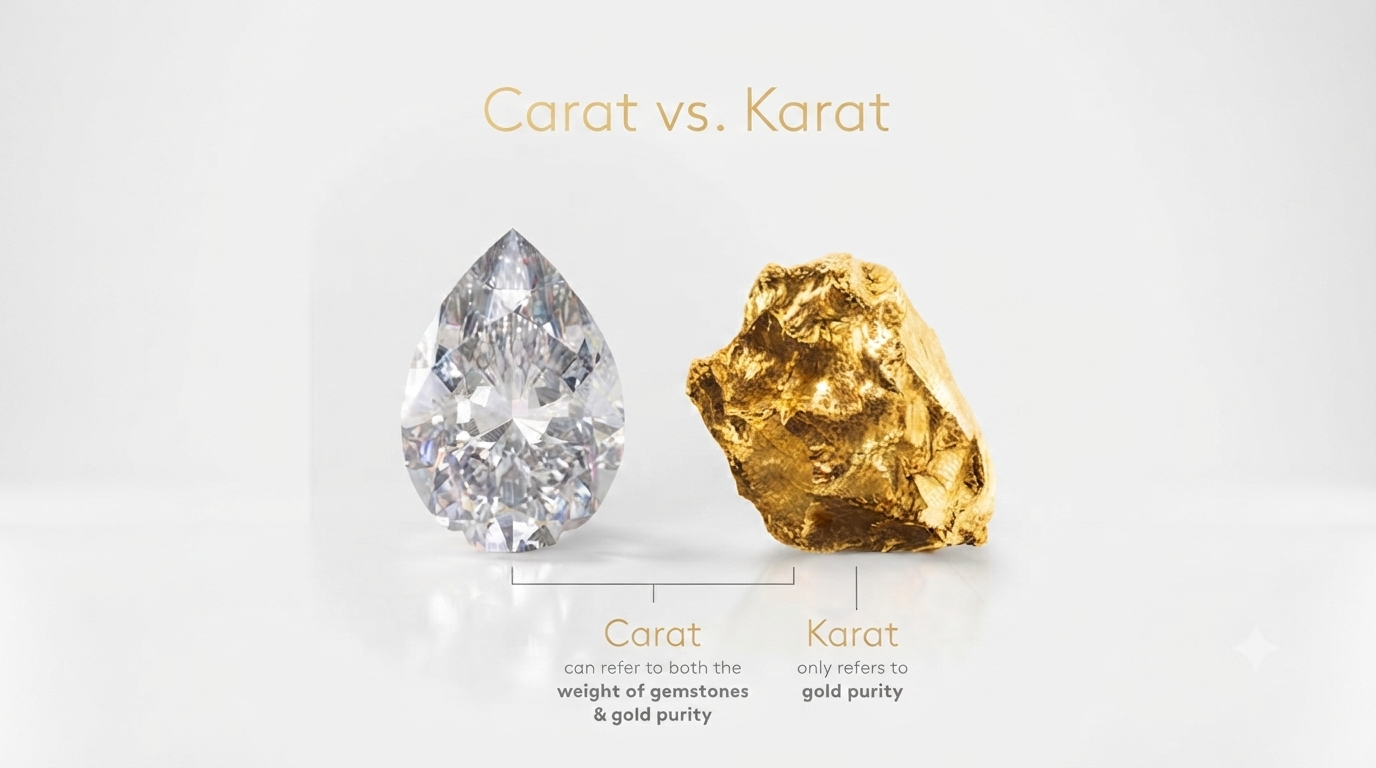
When shopping for fine jewelry or gemstones, you will often run into two words that sound identical but mean completely different things: carat and karat. Mixing them up can lead to major confusion whether you are looking at the weight of a brilliant Ceylon sapphire or the purity of the gold setting holding it in place. Let’s break down the difference simply so you can master it for your jewelry journey.
1. Carat (With a 'C'): The Weight of Gemstones
Carat is a unit of weight used specifically to measure gemstones and diamonds. It measures how heavy the stone is, rather than its physical size. One carat is equal to 0.2 grams (or 200 milligrams). To get more precise, a carat is divided into 100 "points" so a 0.75 carat stone is often referred to as a "seventy-five pointer." While a larger carat weight usually means a larger gemstone, two stones of the exact same carat weight can look different in size depending on how they are cut.
2. Karat (With a 'K'): The Purity of Gold
Karat (often abbreviated as K or kt) is a measure of the purity of gold used in jewelry. It measures the proportion of pure gold alloyed with other metals, like silver, copper, or zinc, to make the jewelry durable enough to wear. Pure 100% gold is measured as 24 karat. Because pure gold is too soft to hold a gemstone securely, it is mixed with other metals: 18K gold contains 75% pure gold, 14K contains 58.3%, and 10K contains 41.7%.
Quick Cheat Sheet & The Takeaway
To sum it up: Carat (with a C) measures the weight of gemstones and diamonds, while Karat (with a K) measures the purity of gold settings. Next time you are admiring a piece of fine jewelry, remember this simple rule: C for Crystals and K for Korrosion resistance/metal purity. Whether you are choosing a heavy Ceylon sapphire or a durable 18 karat gold band, knowing the difference ensures you make a confident investment!